
Introduction: “Recovering your core strength…”
Recovering your core strength after pregnancy or significant weight change is a journey that requires patience and the right knowledge. Many people are eager to jump back into their old fitness routines, but this can sometimes do more harm than good, especially if you have Diastasis Recti. This common condition, often called the “mommy pooch,” involves the separation of your abdominal muscles. While it’s a natural part of many pregnancies, performing the wrong exercises can worsen the separation and delay your healing.
This guide will walk you through the exercises you should absolutely avoid for a safe recovery. We’ll explore why they are problematic and offer insights into what you can do instead. Understanding how to protect your core is the first step toward rebuilding your strength safely and effectively. Let’s dive into what you need to know to heal properly and get back to feeling your best.

Key Takeaways
- Diastasis Recti is the separation of the rectus abdominis muscles, common after pregnancy.
- Certain exercises, especially traditional core work, can increase intra-abdominal pressure and worsen the muscle gap.
- Avoid crunches, sit-ups, planks, double leg lifts, and un-modified push-ups during your initial recovery.
- Focus on gentle exercises that engage the deep core muscles (transverse abdominis) to support healing.
- Always listen to your body and consult a physical therapist for a personalized recovery plan.

Understanding Diastasis Recti
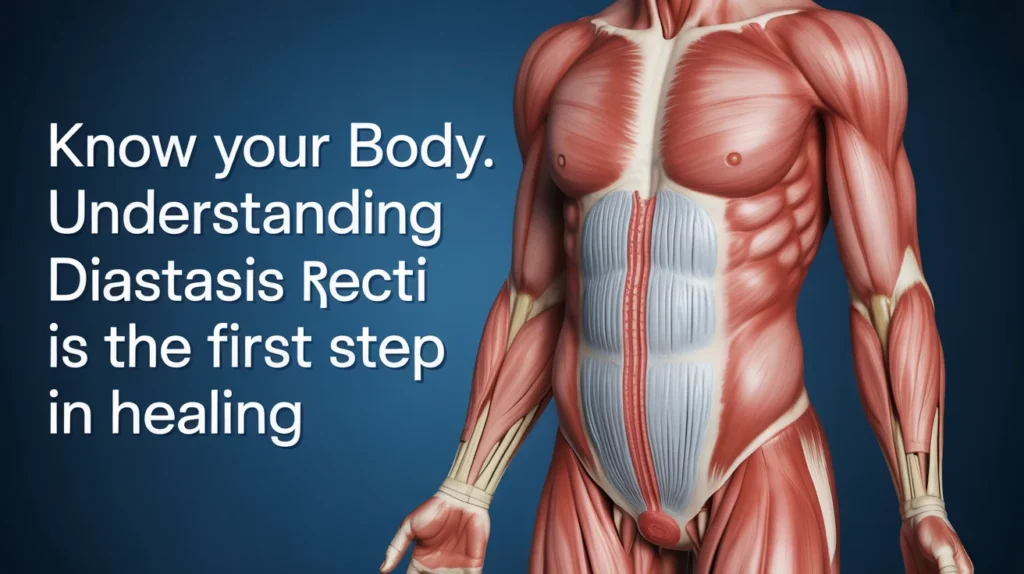
Before we identify the exercises to avoid, it’s important to understand what Diastasis Recti actually is. Your abdomen has a pair of large, parallel muscle bands called the rectus abdominis, or the “six-pack” muscles. These muscles are connected in the middle by a band of connective tissue called the linea alba. During pregnancy, the growing uterus puts significant pressure on these muscles, causing the linea alba to stretch and thin.
This stretching creates a gap between the right and left sides of your abdominal muscles. While it’s most commonly associated with pregnancy, this condition can also affect men and women who have had abdominal surgery, experienced rapid weight fluctuations, or perform exercises with improper form. The separation can lead to a visible bulge in the middle of the abdomen, lower back pain, and a weakened core.
How to Check for Diastasis Recti
You can perform a simple self-check at home to see if you might have this condition.
- Lie on your back with your knees bent and your feet flat on the floor.
- Place one hand on your abdomen, with your fingers pointing toward your toes, along your midline at your navel.
- Gently press your fingertips into your abdomen.
- Lift your head and shoulders off the floor slightly, as if you were starting a crunch. This will engage your abdominal muscles.
- Feel for a gap between the muscle walls. The width of the gap is often measured in finger-widths. A separation of two finger-widths or more is typically considered Diastasis Recti.
If you suspect you have this condition, it is always best to get a formal diagnosis from a healthcare provider or a physical therapist specializing in pelvic floor and postpartum health.

5 Exercises to Steer Clear of for a Safe Recovery
When you have a separation in your abdominal wall, the goal is to bring the muscles back together, not push them further apart. Certain exercises create too much internal pressure, causing the abdominal contents to bulge forward through the weakened linea alba. This can prevent healing and potentially make the gap wider.

Here are the top five exercises you should avoid.
1. Crunches and Sit-Ups
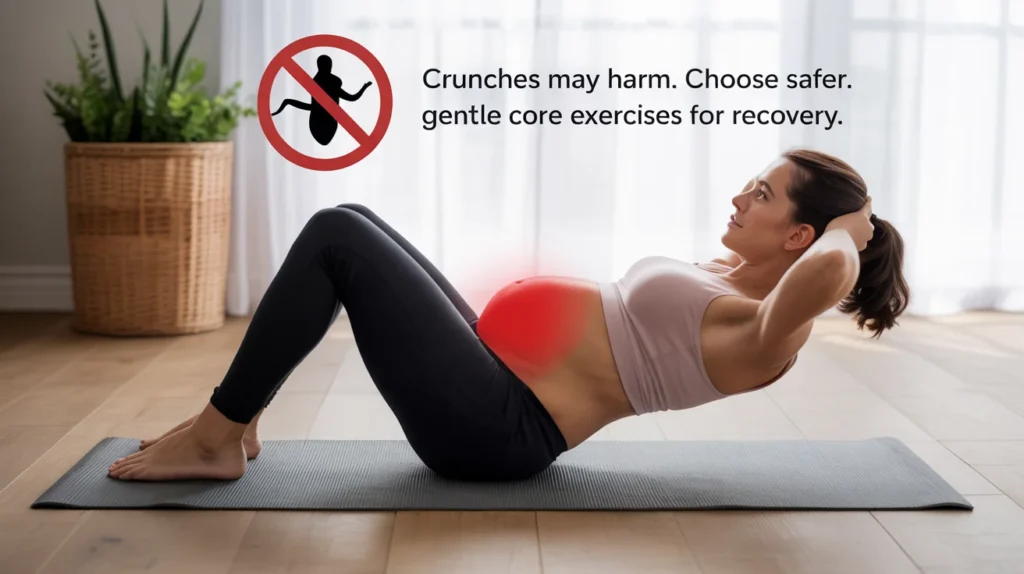
Crunches and sit-ups are perhaps the most well-known “ab” exercises, but they are also the most detrimental for Diastasis Recti. The forward-flexing motion of a crunch puts direct, forceful pressure on the linea alba. Imagine squeezing a tube of toothpaste in the middle—the contents bulge out the ends. A similar action happens in your abdomen.
This repeated pressure can stretch the connective tissue even more, worsening the separation. Instead of strengthening your core in a way that supports healing, crunches create a doming or coning effect along your midline, which is a clear sign that the exercise is inappropriate for your current condition. It is critical to avoid any movement that causes this visible bulging.
2. Standard Planks
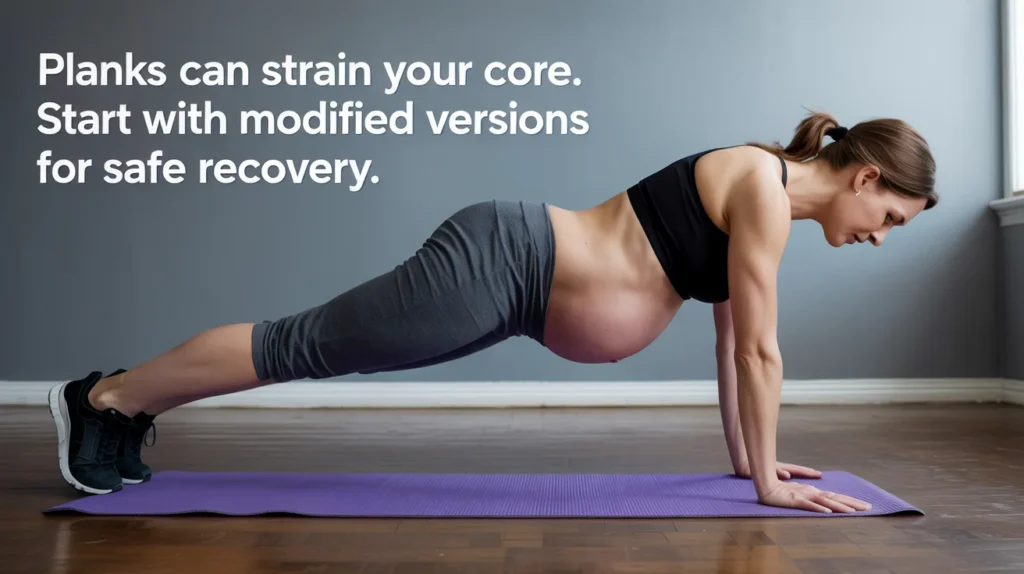
While planks are often celebrated as a great total-core strengthener, a standard front plank can be too demanding for a healing core. Holding a plank position generates a high amount of intra-abdominal pressure. If your deep core muscles, particularly the transverse abdominis (TVA), are not strong enough to counteract this pressure, your abdomen will bulge downward toward the floor.
This places significant strain on the already weakened linea alba. This doesn’t mean you can never do a plank again, but you must work up to it. It’s better to start with modified versions, such as an incline plank against a wall or a knee plank, ensuring you can maintain a flat abdomen without any coning or doming.
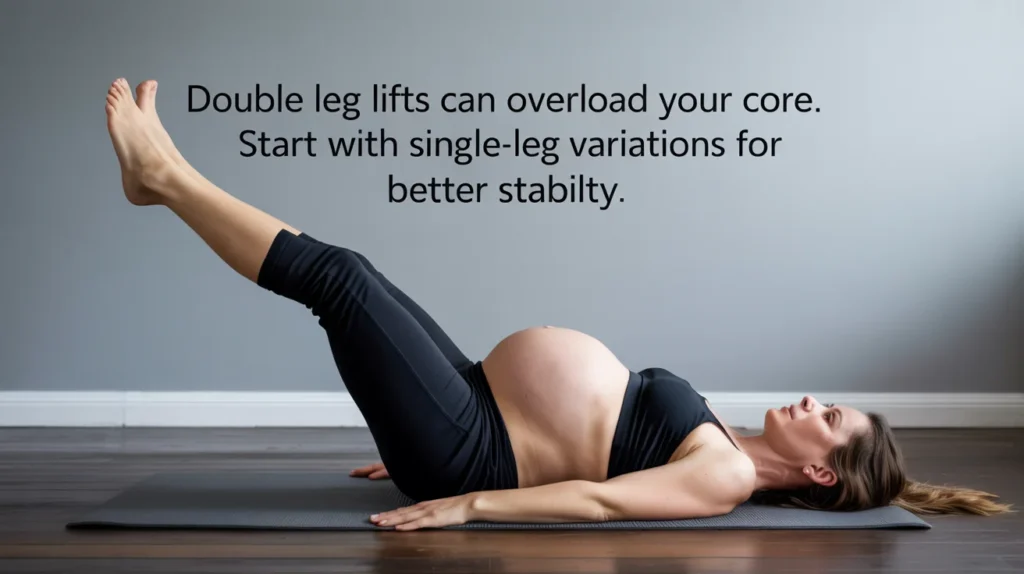
3. Double Leg Lifts
Lying on your back and lifting both legs off the ground simultaneously is an advanced core exercise that places immense strain on the lower abdominals. For someone with Diastasis Recti, the rectus abdominis muscles are unable to properly support this load. As you lower your legs, your back may start to arch, and your abdomen will likely bulge upwards.
This happens because the deep core muscles are not yet strong enough to stabilize your pelvis and manage the pressure. This movement can severely strain your lower back and worsen the abdominal gap. Single-leg variations are a much safer starting point, as they reduce the load and allow you to focus on maintaining core engagement without compromising your form or putting your linea alba at risk.
4. Un-Modified Push-Ups
Similar to a plank, a standard push-up requires a great deal of core stability to maintain a straight line from your head to your heels. The force of gravity pulls your abdomen downward, and without a strong, functional core, your belly will sag. This puts undue stress on the connective tissue joining your abdominal muscles.
The pressure created during the movement can prevent the linea alba from healing and may even exacerbate the separation. It’s much safer to modify this exercise until your core is stronger. You can start with wall push-ups or incline push-ups on a sturdy surface. As you get stronger, you can progress to knee push-ups before attempting a full push-up, always monitoring for any signs of abdominal doming.

5. Heavy Lifting with Improper Breath Control
This isn’t a single exercise, but a crucial principle that applies to all forms of resistance training. Lifting heavy weights without using the correct breathing technique can dramatically increase intra-abdominal pressure. Many people instinctively hold their breath when exerting force (a technique called the Valsalva maneuver). This action traps air in the chest and abdomen, creating a surge of internal pressure that pushes out against the abdominal wall. For someone with Diastasis Recti, this can be very damaging. It’s essential to learn how to exhale on exertion. By breathing out as you lift, push, or pull, you naturally engage your deep core muscles and reduce the pressure on your linea alba, protecting it as it heals.

Safe Exercises vs. Unsafe Exercises: A Comparison
To help you visualize the difference, here is a simple comparison of exercises to avoid and their safer alternatives.
| Exercise to Avoid | Why It’s Unsafe for Diastasis Recti | Safe Alternative | Why It’s Better |
|---|---|---|---|
| Crunches/Sit-Ups | Creates forward pressure that widens the gap. | Heel Slides | Gently engages the deep core (TVA) without pressure. |
| Standard Plank | Too much pressure; causes abdominal sagging. | Incline Plank | Reduces the load and makes it easier to keep the core engaged. |
| Double Leg Lifts | Overloads the core and strains the lower back. | Single Leg Lifts/Toe Taps | Isolates movement and builds stability gradually. |
| Standard Push-Ups | High core demand leads to abdominal bulging. | Wall or Knee Push-Ups | Lessens the gravitational pull on the abdomen. |
| Breath Holding | Spikes intra-abdominal pressure. | Exhaling on Exertion | Activates the core and protects the linea alba. |

Building a Strong Foundation: What to Do Instead
So, if you can’t do traditional ab workouts, what should you do? The key is to focus on strengthening your deepest core muscle: the transverse abdominis (TVA). Think of the TVA as your body’s natural corset. When it’s strong, it wraps around your midsection and provides stability, helping to pull the two sides of the rectus abdominis back together.
Core-Safe Exercises to Promote Healing
Here are some gentle exercises that are excellent for rebuilding your core after experiencing Diastasis Recti.
- Pelvic Tilts: Lie on your back with your knees bent. Gently flatten your lower back against the floor by engaging your abdominal muscles, then release.
- Heel Slides: While lying on your back, slowly slide one heel away from your body, keeping your pelvis stable. Return to the start and alternate legs.
- Glute Bridges: Lie on your back with knees bent. Lift your hips off the floor until your body forms a straight line from your shoulders to your knees. Squeeze your glutes at the top.
- Diaphragmatic Breathing (Belly Breathing): Focus on deep breathing that expands your rib cage and engages your diaphragm and pelvic floor. This is foundational for all other exercises. More information on postpartum physical activity can be found through trusted sources like the American College of Obstetricians and Gynecologists (ACOG).
When starting any new exercise program for Diastasis Recti, it is highly recommended to seek guidance from a qualified professional. A physical therapist who specializes in postpartum recovery or pelvic health can provide a personalized plan to ensure you are performing exercises correctly and safely. They can help you progress at the right pace and get you back to your favorite activities without risking injury. According to Johns Hopkins Medicine, physical therapy is a key component of a successful recovery.

Conclusion
Recovering from Diastasis Recti is a process that demands patience, awareness, and the right approach. While it can be tempting to rush back into intense workouts, avoiding high-pressure exercises like crunches, traditional planks, and double leg lifts is crucial for safe and effective healing. Instead, shift your focus to gentle movements that activate your deep core muscles and support the realignment of your abdominal wall.
By embracing modifications and listening to your body, you can build a strong, functional core from the inside out. Always remember that seeking professional guidance from a physical therapist can make all the difference in your recovery journey, providing you with the confidence and tools you need to heal correctly.

Frequently Asked Questions (FAQ)
1. How long does it take for Diastasis Recti to heal?
Healing time varies for everyone. Factors include the severity of the separation, consistency with corrective exercises, and overall health. For some, it may improve in 6-12 weeks, while for others, it may take several months or longer. Patience is key.
2. Can Diastasis Recti be fixed without surgery?
Yes, many cases of Diastasis Recti can be significantly improved or fully resolved through targeted physical therapy and corrective exercises. Surgery is typically considered a last resort for severe cases that don’t respond to conservative treatment.
3. Is it ever too late to heal Diastasis Recti?
No, it is never too late. Even years after pregnancy or injury, you can still improve core function and reduce the abdominal separation with the right exercises and strategies.
4. Can men get Diastasis Recti?
Yes. Although it is most common in postpartum women, men can also develop Diastasis Recti. It can be caused by yo-yo dieting, performing abdominal exercises with poor form, or other activities that cause excessive intra-abdominal pressure.
5. What does “coning” or “doming” of the abdomen look like?
Coning is when a ridge or cone-shaped bulge appears down the midline of your stomach during exercise. This is a sign that the exercise is putting too much pressure on your linea alba and should be stopped or modified immediately.