Introduction
Recovering from a cesarean section is a unique journey that requires patience, grace, and a deep understanding of your body’s needs. Unlike a vaginal birth, a C-section is major abdominal surgery. While you’re navigating the beautiful, chaotic world of new motherhood, your body is working hard to heal multiple layers of tissue. It’s easy to feel pressure to “bounce back,” but a gentle and mindful approach is not just recommended—it’s essential for your long-term health and well-being.
For busy moms, the challenge is twofold: caring for a newborn while giving your own body the attention it needs to recover properly. This is where focusing on the right things from the start can make all the difference.

Your C-section recovery isn’t about jumping back into intense workouts. It’s about rebuilding your foundation from the inside out with safe, targeted practices that support your healing.
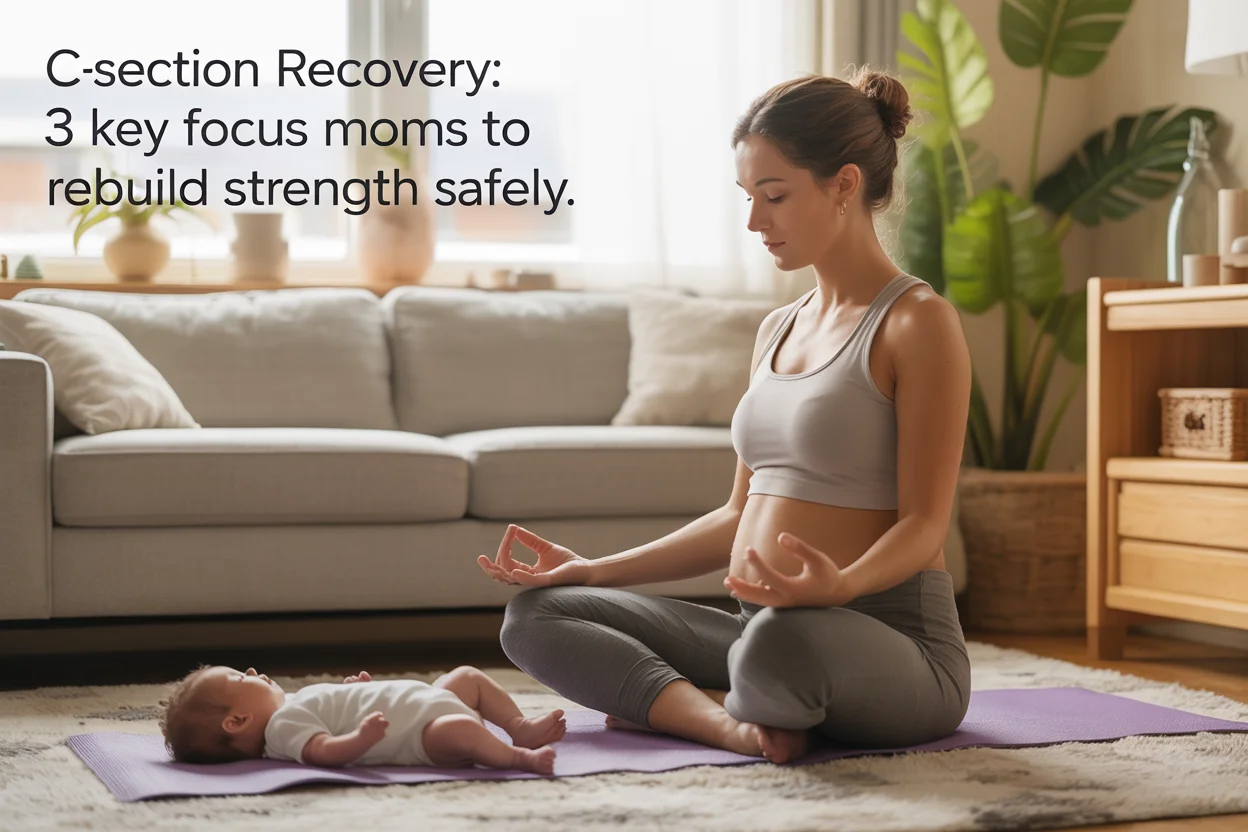
This guide will walk you through the first three things to focus on during your postpartum fitness journey. We’ll explore simple, safe exercises for moms that you can integrate into your daily routine, helping you feel stronger, reduce discomfort, and connect with your body in a new and powerful way.
1. Reconnecting with Your Breath and Deep Core
After a C-section, the connection between your brain and your abdominal muscles can feel lost. The incision, swelling, and tenderness can make you hesitant to engage your midsection at all. However, the first and most critical step in C-Section Recovery is to re-establish this connection through gentle, intentional breathing. This isn’t just about relaxation; it’s a powerful tool for activating your deepest core muscles without straining your incision.
Your deep core system includes the diaphragm (your primary breathing muscle), the transverse abdominis (TVA), and the pelvic floor. These muscles work together like a canister to stabilize your trunk. Learning to coordinate them again is the foundation of all future movement and strength.

Why It’s Crucial for C-Section Recovery
Proper diaphragmatic breathing helps to gently mobilize the scar tissue forming around your incision, which can prevent it from becoming overly tight or restrictive. It also naturally activates the TVA, the body’s internal corset, which provides support for your healing abdomen and lower back. This process reduces intra-abdominal pressure, protecting your incision and pelvic floor from unnecessary strain.

Safe Exercise: 360-Degree Breathing
This foundational practice teaches you to use your full lung capacity and engage your core system in a supportive way.
How to Do It:
- Lie on your back with your knees bent and feet flat on the floor. You can also do this sitting comfortably in a chair.
- Place your hands on the sides of your ribcage.
- Close your eyes and take a slow, deep inhale through your nose for a count of four. Imagine your breath expanding not just your belly, but your ribs out to the sides and into your back. Your hands should feel like they are moving apart.
- Exhale slowly through your mouth for a count of six, as if you’re gently blowing out a candle. As you exhale, feel your ribs naturally come back together. You can add a gentle “hugging” sensation, drawing your navel toward your spine without force.
- Pause for a moment before your next inhale. Repeat for 10-12 breaths.

Tips for Busy Moms:
You can practice this anywhere, anytime. Do a few rounds while you’re feeding your baby, lying in bed in the morning, or as you wait for the kettle to boil. The key is consistency, not intensity. This simple practice calms the nervous system and retrains your core muscles to function correctly.

2. Prioritizing Posture and Alignment
The physical demands of motherhood—carrying, feeding, and comforting a baby—can wreak havoc on your posture. After a C-section, there is a natural tendency to hunch forward to protect your tender abdomen. While this is a normal protective mechanism, staying in this position for too long can lead to back pain, neck strain, and a weakened core.
Focusing on gentle posture correction helps to realign your body, allowing your muscles to function optimally. Good alignment stacks your ribcage over your pelvis, which distributes pressure evenly and reduces strain on your healing incision and lower back.

Why Posture is Crucial for C-Section Recovery
Poor posture puts constant, unnecessary pressure on your abdominal wall and pelvic floor, which can interfere with the healing of your linea alba and C-section scar. By consciously working on your alignment, you encourage your deep core muscles to engage naturally throughout the day, providing continuous support for your spine and pelvis. This is a form of passive exercise that works for you 24/7.

Safe Practice: Wall Stands and Gentle Stretches
This simple exercise helps you feel what good alignment is and can be done in just a few minutes.
How to Do It (Wall Stands):
- Stand with your back against a wall, with your feet a few inches away from the baseboard.
- Your head, shoulder blades, and tailbone should be in contact with the wall. There may be a small, natural curve in your lower back.
- Gently tuck your chin, as if you are making a double chin, to lengthen the back of your neck.
- Roll your shoulders back and down, away from your ears.
- Engage in your 360-degree breathing, feeling your core support this upright posture. Hold for 30-60 seconds.
Gentle Chest Stretch:
Stand in a doorway and place your forearms on the frame, with your elbows slightly below shoulder height. Step one foot forward into a gentle lunge until you feel a light stretch across your chest. Hold for 20-30 seconds while breathing deeply. This counteracts the rounding forward that is so common in early motherhood.

Tips for Busy Moms:
Set up your feeding station to be posture-friendly. Use pillows like the My Brest Friend or Boppy to bring the baby up to your breast level, so you aren’t hunching over. When you’re pushing a stroller, keep your shoulders back and avoid leaning on the handlebar. Take a moment to do a wall stand whenever you’re waiting for something in the kitchen.

3. Encouraging Gentle, Functional Movement
Once you have the green light from your doctor (usually around 6-8 weeks postpartum), you can begin to introduce more active, functional movements. The goal here is not to “work out” in the traditional sense, but to re-teach your body how to move safely and efficiently during daily activities.
Functional movements mimic the things you do every day, like lifting your baby from the crib, getting up off the floor, or carrying groceries. By practicing these motions with proper form and core engagement, you build strength that directly translates to your life as a mom, all while protecting your healing body.

Why Gentle Movement is Crucial for C-Section Recovery
After surgery, your body develops compensatory patterns to avoid pain. For example, you might rely heavily on your back muscles to lift or use only one side of your body. Intentional, gentle movement helps to correct these imbalances and retrain your core to be the central stabilizer for all movements. This prevents long-term issues like chronic back pain and pelvic floor dysfunction.

Safe Exercises: Glute Bridges and Bodyweight Squats
These two exercises are powerhouse movements for postpartumC-Section Recovery because they strengthen your glutes and legs, which are essential for supporting your core.
How to Do It (Glute Bridges):
- Lie on your back with your knees bent, feet flat on the floor hip-width apart, and your arms resting by your sides.
- Inhale to prepare. As you exhale, use your 360-breathing technique to engage your deep core.
- Press through your heels and squeeze your glutes to lift your hips off the floor, creating a straight line from your shoulders to your knees. Avoid arching your back; the work should come from your glutes.
- Hold for a moment at the top, then slowly lower back down with control. Perform 10-12 repetitions.
How to Do It (Bodyweight Squats to a Chair):
- Stand in front of a sturdy chair with your feet slightly wider than hip-width apart.
- Inhale as you send your hips back and down, as if you are about to sit in the chair. Keep your chest up and your weight in your heels.
- Lightly tap the chair with your bottom, or sit down completely if needed.
- Exhale and press through your feet to stand back up, squeezing your glutes at the top. Perform 8-10 repetitions.

Tips for Busy Moms:
Practice squatting every time you sit down or stand up. Instead of just plopping onto the couch, do it with control. Use the glute bridge movement to help you get out of bed: roll to your side, then push up, using your glutes to assist. These small tweaks turn everyday actions into C-Section Recovery opportunities.

Conclusion: Your C-Section Recovery, Your Timeline
Your C-section recovery is a personal journey, not a race. The first few months postpartum are a time for deep healing and reconnection. By focusing on your breath, posture, and gentle functional movement, you are laying the strongest possible foundation for your future health and fitness. Be patient with your body and celebrate every small step forward.
Consistency will always be more valuable than intensity during this phase. A few minutes of intentional breathing and mindful movement each day will yield far greater results than pushing yourself too hard, too soon. Listen to your body, honor its need for rest, and give yourself the same grace you so freely give to your new baby.

Ready to take the next step in your healing? Save this article to your Pinterest board for easy reference. And most importantly, always consult with your doctor or a pelvic floor physical therapist for personalized advice tailored to your unique recovery needs. You’ve done something amazing, and you deserve to feel strong and confident in your postpartum body.