
Introduction
Life as a busy mom is a juggling act. Between school runs, meal prep, work, and managing the household, your own well-being can often take a backseat. This constant motion, especially lifting children, carrying heavy grocery bags, and hunching over laptops, can lead to persistent aches, with Shoulder Pain being a common complaint. This discomfort can make even simple tasks feel monumental.
The good news is that you don’t have to simply endure it. By incorporating a few simple, targeted exercises into your packed schedule, you can find significant relief, improve your mobility, and strengthen the muscles that support your shoulder joint.

This guide is designed specifically for you—the busy mom who needs effective solutions that don’t require hours at the gym. We’ll explore six gentle yet powerful exercises to help you manage and reduce shoulder discomfort, allowing you to get back to what matters most, feeling strong and pain-free.
Key Takeaways
- Consistency is Key: Performing these gentle exercises regularly is more effective than infrequent, intense workouts for managing Shoulder Pain.
- Posture Matters: Many shoulder issues stem from poor posture. Being mindful of how you sit, stand, and lift throughout the day is crucial.
- Listen to Your Body: Never push through sharp pain. These exercises should feel like a gentle stretch, not a strain.
- Strength and Flexibility: A combination of stretching and strengthening exercises provides the best support for a healthy shoulder joint.
- Small Changes, Big Impact: Even a few minutes of dedicated movement each day can make a significant difference in your pain levels and overall mobility.
Understanding the Root Causes of Shoulder Discomfort in Moms
The shoulder is the body’s most mobile joint, which also makes it prone to instability and injury. For moms, the daily physical demands are unique and repetitive. Constantly lifting and carrying a growing child, often on the same side, creates an imbalance in your muscles.
Add to that the hours spent leaning over a crib, pushing a stroller, or carrying a heavy diaper bag, and you have a perfect recipe for strain. This repetitive stress can lead to inflammation of the tendons (tendinitis) or the bursa (bursitis), contributing to persistent Shoulder Pain.

Furthermore, modern life often involves long periods of sitting—whether working from home, helping with homework, or finally getting a moment to relax. This can lead to what’s known as “forward head posture,” where your shoulders round forward and your head juts out.
This position puts immense strain on your neck and upper back muscles, which are directly connected to your shoulder complex. Over time, this poor posture weakens the muscles in your upper back and tightens the muscles in your chest, pulling the shoulder joint out of its optimal alignment and causing friction and discomfort.
6 Gentle Exercises for Lasting Shoulder Pain Relief
Before starting any new exercise routine, especially if you’re experiencing significant pain, it’s wise to consult with a healthcare professional. These exercises are designed to be gentle, but it’s important to stop if you feel any sharp or sudden pain.
1. The Pendulum Stretch
This is an excellent warm-up exercise that gently stretches the capsule of the shoulder joint without requiring you to actively lift your arm, making it ideal if you’re experiencing acute Shoulder Pain.
How to Perform the Pendulum Stretch:
- Find a sturdy table or countertop and stand beside it.
- Lean forward slightly, placing your pain-free hand on the table for support.
- Let your affected arm hang straight down toward the floor.
- Relax your shoulder muscles and gently swing the arm in small circles, as if it were a pendulum. Start with about 10 circles in a clockwise direction.
- Reverse the direction and swing the arm for another 10 circles counter-clockwise.
- You can also try swinging it forward and backward, and side to side.
- Perform one set of 10 repetitions in each direction, once a day. As your shoulder feels better, you can gradually increase the diameter of the swing.
This movement helps to increase blood flow to the area and provides gentle traction, creating space within the joint to reduce pressure and ease stiffness.

2. Doorway Stretch for Chest and Shoulders
Tight chest muscles are a major contributor to rounded shoulders and subsequent pain. This stretch uses a simple doorway to open up the chest, counteract slouching, and relieve pressure on the front of your shoulder.
How to Perform the Doorway Stretch:
- Stand in an open doorway.
- Raise your arms to the side, bent at a 90-degree angle with your palms facing forward (like a goalpost).
- Place your palms and forearms on the doorframe.
- Step forward with one foot, gently leaning your body through the doorway until you feel a light stretch across your chest and the front of your shoulders.
- Hold this position for 20-30 seconds, breathing deeply. Ensure you aren’t arching your lower back.
- Step back to release the stretch. Repeat this 3 times.
This is a fantastic stretch to do throughout the day, especially if you’ve been sitting for a long time or after feeding or holding your baby.

3. Wall Push-Ups
Wall push-ups are a modified version of the classic exercise, making them much kinder to the shoulder joint. They are excellent for strengthening the serratus anterior, a key muscle for shoulder blade stability, without putting excessive strain on the joint.
How to Perform Wall Push-Ups:
- Stand facing a wall, about arm’s length away.
- Place your palms flat on the wall at shoulder height and slightly wider than your shoulders.
- Keeping your back straight and your core engaged, slowly bend your elbows and lean your body toward the wall until your nose is close to it.
- Pause for a moment, then press back firmly to the starting position. Focus on feeling your shoulder blades move as you push.
- Aim for 2 sets of 10-15 repetitions.
This exercise helps re-train proper movement patterns and builds foundational strength that protects the shoulder from future injury.

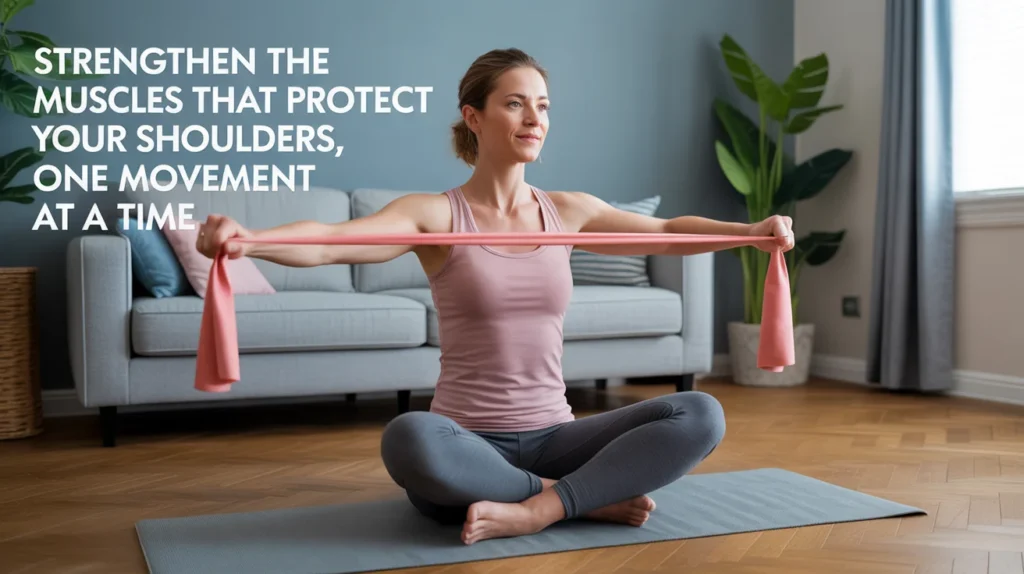
4. External Rotation with Resistance Band
Weak rotator cuff muscles are a common cause of Shoulder Pain. This exercise specifically targets the external rotators, which help stabilize the “ball” of the upper arm bone within the shoulder “socket.” You’ll need a light resistance band for this.
How to Perform External Rotation:
- Stand or sit with good posture, holding a resistance band with both hands, palms facing up.
- Pin your elbows to your sides at a 90-degree angle.
- Keeping your elbows tucked in, slowly pull the band apart by rotating your forearms outward.
- Squeeze your shoulder blades together as you move. Only go as far as you can without your elbows leaving your sides.
- Hold for a second, then slowly return to the starting position.
- Complete 2 sets of 15 repetitions.
According to the American Academy of Orthopaedic Surgeons, strengthening the rotator cuff is a primary component of treating many types of shoulder issues. This exercise directly addresses that need.
5. Scapular Squeezes
This simple movement can be done anywhere—even while waiting in the carpool line! It focuses on activating the muscles between your shoulder blades (the rhomboids and middle trapezius), which are essential for maintaining good posture and preventing your shoulders from rounding forward.
How to Perform Scapular Squeezes:
- Sit or stand tall with your arms relaxed at your sides.
- Imagine you are trying to hold a pencil between your shoulder blades.
- Gently squeeze your shoulder blades together and down, away from your ears.
- Hold the squeeze for 5 seconds, making sure you aren’t shrugging your shoulders up.
- Relax and return to the starting position.
- Repeat this 10-15 times.
This is less of a workout and more of a postural re-education tool. Doing it frequently reminds your muscles where they should be, helping to combat the effects of slouching.

6. Child’s Pose
While often associated with yoga, Child’s Pose is a wonderful restorative posture that provides a gentle stretch for the entire back, lats, and shoulders. It helps to release tension built up from a long day of lifting and carrying.
How to Perform Child’s Pose:
- Kneel on the floor or a mat. Touch your big toes together and sit back on your heels.
- Separate your knees about as wide as your hips.
- Exhale and lay your torso down between your thighs.
- Stretch your arms out in front of you with your palms on the floor, feeling a stretch through your shoulders and back.
- Rest your forehead on the mat and breathe deeply into your back.
- Hold for 30 seconds to a minute, or as long as it feels comfortable.
This pose is not just a physical stretch but also a moment to calm your nervous system, making it a perfect way to end your short exercise routine.

Exercise Comparison for Quick Reference
| Exercise | Primary Goal | Best For |
|---|---|---|
| Pendulum Stretch | Gentle mobilization | Acute pain, warm-up |
| Doorway Stretch | Increasing flexibility | Tight chest, poor posture |
| Wall Push-Ups | Building stability | Weak shoulder blade muscles |
| External Rotation | Strengthening rotator cuff | General weakness, instability |
| Scapular Squeezes | Improving posture | Rounded shoulders, desk work |
| Child’s Pose | Releasing tension | Overall stiffness, relaxation |

Lifestyle Adjustments to Prevent Shoulder Pain
While exercises are crucial, making small adjustments to your daily habits can also provide immense relief and prevent the recurrence of Shoulder Pain. Try to be mindful of how you move throughout your day. When lifting your child, bend at your knees and engage your core instead of straining your back and shoulders.
Alternate which side you carry your child or your purse on to avoid creating muscle imbalances. When working at a computer, ensure your screen is at eye level and your chair supports good posture, as recommended by institutions like the Mayo Clinic. Taking short, frequent breaks to stand up and do a few scapular squeezes or a doorway stretch can interrupt the cycle of muscle tension and prevent discomfort from setting in.

Conclusion
Managing Shoulder Pain as a busy mom can feel like another item on an already endless to-do list, but it doesn’t have to be complicated. By dedicating just 10-15 minutes a day to these six simple exercises, you can build strength, increase flexibility, and correct the postural imbalances that cause discomfort. Consistency is far more important than intensity.
Listen to your body, celebrate small improvements, and remember that taking care of yourself enables you to better care for your loved ones. You deserve to move through your day with strength and without pain.

Frequently Asked Questions (FAQs)
Q1: How often should I do these exercises?
For the best results, aim to perform the stretching exercises daily and the strengthening exercises (Wall Push-Ups, External Rotation) every other day to give your muscles time to recover and rebuild.
Q2: Can I do these exercises if I’m pregnant?
Most of these exercises are gentle and safe during pregnancy. However, it’s always best to consult with your doctor or a physical therapist before starting any new routine while pregnant. Pay close attention to your body and avoid any movements that cause discomfort.
Q3: What if the pain gets worse after exercising?
You should feel a gentle stretch or muscle fatigue, but not sharp pain. If your Shoulder Pain increases after performing these exercises, stop immediately. It could mean the exercise is too strenuous for your current condition or that you may have an underlying issue that requires medical attention.
Q4: Do I need any special equipment?
Most of these exercises require no equipment at all. For the External Rotation, a light resistance band is needed. These are inexpensive and widely available online or in sporting goods stores. You can start with the lightest resistance and progress as you get stronger.